Our Research
From simple machines and devices to "powertrains" for in-solution and material applications
Our research focuses on the design of complex molecular devices, resulting from the assemblies of several motors, switches, shafts, or gears that operate in concert, enabling complex behaviours and representing a stepping stone toward artificial "living" systems. We plan to use those molecular devices, analogous to the macroscopic concept of a powertrain, for in-solution applications (for example, chemotaxis) and material science. To do so, we take a fully artificial bottom-up approach, designing simple artificial molecular machines such as motors and switches and looking at a broad range of energy sources such as chemical fuels, light, and electrochemistry.
Endergonic synthesis and "mechanised synthesis"
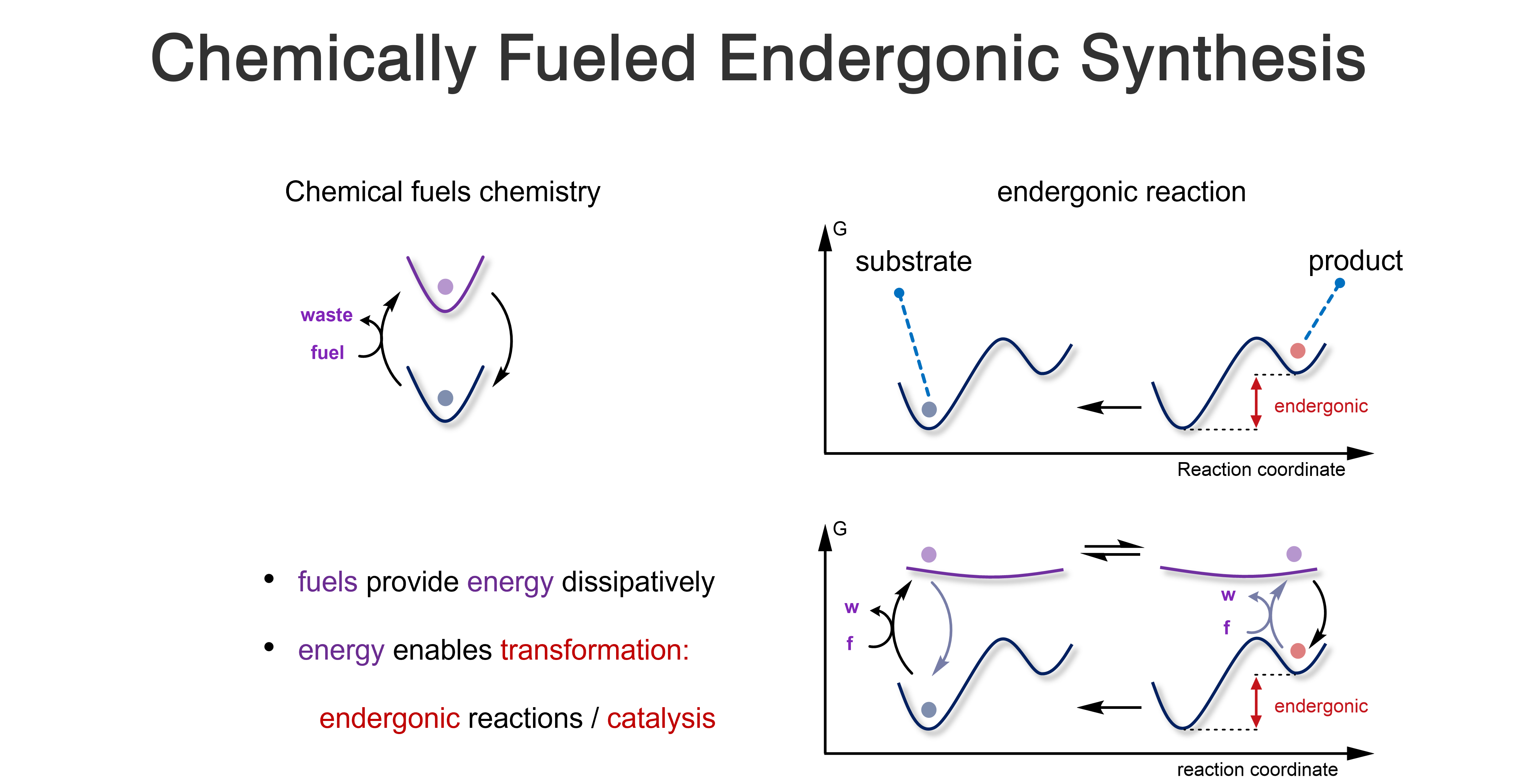
A particular ambition of our work is to harness molecular machinery for chemical synthesis, drawing inspiration from ATP synthase—the biological engine that couples mechanical rotation to endergonic bond formation. In such systems, energy from a fuel is orthogonally transferred to drive thermodynamically uphill reactions, achieving what we describe as mechanised synthesis, where a molecular machine directly powers a chemical transformation.
As a stepping stone toward this goal, we are currently developing minimalistic model systems that reproduce the core principle of ATP synthase—the directed transfer of energy from a consumed fuel into a chemical reaction. These simplified platforms allow us to isolate and quantify the key mechanistic features of fuel-driven synthesis, establishing design rules that will guide the progressive complexification of our systems. By incrementally introducing mechanical coupling, we aim to pave the way toward synthetic analogues of ATP synthase, capable of mechanised synthesis.